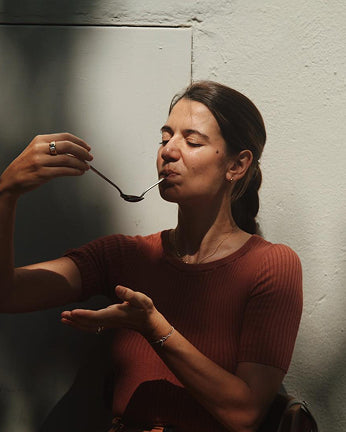
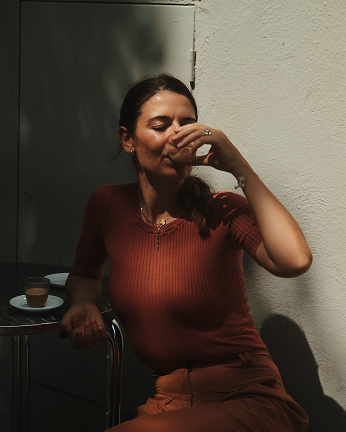
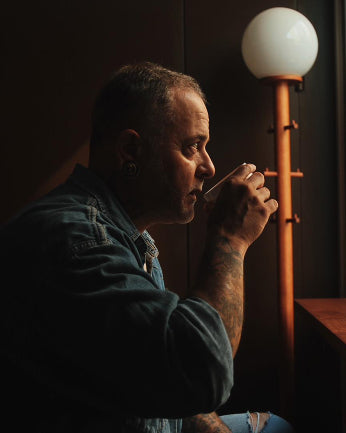
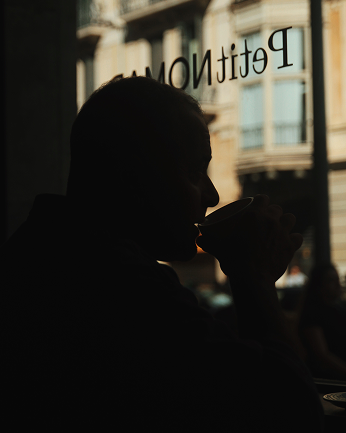
Everyone has their own idea of what makes a good cup of coffee. It’s a personal journey, shaped by the preferences we develop as we grow and change, by our different moods, and by the people we meet along the way.

Behind every cup lie quirks, memories, rituals, and small gestures—things that speak not only to how we like to drink it, but also to who we are and how we understand the world around us. 

(03)
Dear Nomad:

From: Sergi Subject: Another Way

Play Unmute

A little quirk, a way of seeing the world
.

Nomad Coffee
Nomad Coffee
Nomad Coffee
Nomad Coffee
Nomad Coffee
Nomad Coffee
(02)
Dear Nomad:

From: Alba Subject: The Order of Chaos

Play Unmute

Everyone finds their own way to bring
order to their world.

Nomad Coffee
Nomad Coffee
Nomad Coffee
Nomad Coffee
Nomad Coffee
(01)
Dear Nomad:

From: Georgina Subject: Family Heirlooms

Play Unmute
Nomad Coffee
Nomad Coffee

Objects that become memories.

Nomad Coffee
Nomad Coffee
Nomad Coffee

What do you need to
start your own story?

What's your story with coffee?

Maybe it starts with one person, in a coffee shop, or with a mug you bought while traveling. A morning ritual, a tradition passed down, or a routine you think works only for you. Every story has something to tell.

Dear Nomad:

From: Fabi / Subject: A HOME 12,000 KM AWAY FROM HOME.

I’m writing this from my little apartment in the Raval. I have the window open because, even though it’s mid-September, it’s still hot. I live across from a plaza; it’s 7 p.m., and there are kids playing, dogs barking, and friends chatting on the terrace of the bar across the street. If I go downstairs and walk to the right, there’s the neighborhood bakery; and if I keep going 400 meters, I’ll end up right at my favorite coffee shop. Today I went there for my third cup of coffee of the day. I didn’t really need that third cup of coffee. But I did need to greet someone with the warmth that comes from a routine.

I had my first cup of coffee when I was 29. I think that’s one of my weirdest fun facts—of the ones I can admit to—considering I’ve been working with coffee for much longer than that. In my childhood home, we drank mate, not coffee. So, even though I’m a very melancholic person, there’s no nostalgia here at all. That devotion I feel for my little cup of coffee takes me nowhere else but Barcelona. That memory is tied to this city.

Almost all of the 12 years I’ve spent here have been intertwined with coffee. Far from my comfort zone, my friends, and my family, I had to become a different version of myself. I had to create new routines and a new comfort zone with new friends. This is where I began to find that hope in coffee shops—in meeting up for a cortado after lunch, in trying the filter coffee a random colleague brought back from Denmark—the hope that, even though I’m 12,000 kilometers away from my first favorite place in the world, I can build other favorite places, other rituals, and keep them alive.

Apparently it’s going to rain tomorrow and the temperature will drop. I’ll head out to grab a slice of Forner’s coca for breakfast with a cup of batch, watching the empty plaza in the morning and the girl at the bar across the street also sipping her first coffee with a cigarette before setting up the outdoor seating area.

Play Unmute
Dear Nomad:

From: Roberto / Subject: Four Giny

A few years ago, I had an old manual coffee grinder: as you turned the handle, you had to earn your daily cup of coffee, but it was worth it. Later, since my job was taking up an increasingly large portion of my time, I had to give up that magic and switch to an electric one. But coffee makers—those are off-limits: I have four, and they’re all strictly necessary.

A Venezuelan friend who was clearing out her house in Tenerife gave me the French press as a gift. It fits perfectly into my morning routine: a little over a minute, neither too strong nor too weak—it’s my favorite coffee. It makes no more than two cups, and that’s perfect: the first on the terrace, the second right when I get to work.

For days on call, there’s the filter coffee maker, which is programmable. Although I’m not entirely convinced by the result, waking up to that heavenly aroma that already fills the house makes me feel privileged, and it makes enough that I can fill a large thermos. A twenty-four-hour workday is already unbearable enough on its own, and things get even worse if you have to resort to those horrible capsules or—argh!—instant coffee.

The moka pot, on the other hand, is for the afternoon. When I put it on the stove, I think of my grandmother, sitting there waiting to see the first drop fall before turning off the flame at the first “glo-glo.” “The consistency is different; you have to stir it,” she’d say as she swirled a small spoon inside the pot, before pouring the coffee into the green glass cups from our beach house. She’d serve store-bought, bitter coffee and add white sugar. Every now and then I do the same, to honor her memory.

I gave the Pavoni to my father, and it pained me to see that the two of them didn’t click. But it takes time for the machine to warm up, and my old man always has great patience—except when he wants to have a cup of coffee. So I took it back, and I break it out when I have guests over for afternoon tea: that chrome lever you have to push down impresses everyone, and the espresso that comes out of it is perfect for making an affogato.

Four mugs, four drinks, four unforgettable moments. As I’m writing this, I’ve gotten the urge to look for the fifth one…

Dear Nomad:

From: Ryan / Subject: Impromptu coffee in Madrid

I remember that café almost as clearly as I remember Madrid.

It was already mid-morning, hot enough that we’d started looking for the shady side of every street. We’d been walking aimlessly for a while, in that in-between moment between breakfast and whatever came next, when we found a small café tucked away from the busiest streets. Inside, it was cool and calm, with the soft clinking of cups and the low murmur of conversation.

I ordered an espresso. The barista told me they used beans from NOMAD, a Barcelona-based Roaster I’d heard of but had never tried. It struck me as a bit odd to find coffee from Barcelona in Madrid, but at the time I didn’t think much of it.

The coffee arrived in a small ceramic cup, with a glass of water beside it. I remember that the first sip was unexpectedly bright: fruity and almost sweet, without the intense bitterness I usually associated with espresso. After that, I relaxed. Instead of drinking it quickly and heading back out, I stayed there, turning the cup in my hands and taking small sips while watching people pass by the window.

There was nothing particularly significant about that morning. We didn’t visit any famous monuments or have any great revelations. After the coffee, we paid, stepped back out into the Madrid sunshine, and kept walking.

But, somehow, that’s precisely why I remember it.

Years later, every time I see a bag of beans from NOMAD, I think of that little café: the cool room, the intense light from outside, my legs tired from all the walking, and that feeling of not having to be anywhere in particular. For a few minutes, Madrid was reduced to something very simple: a small cup of coffee, a chair by the window, and time passing unusually slowly.

Dear Nomad:

From: Seva / Subject: Where Water Boils at 86 Degrees

In the mountains, almost everything is simplified. You sleep fully clothed, shower every three days, and eat whatever’s available. Comfort fits inside your sleeping bag, and it’s a fair trade: you sacrifice comfort for what you came here for—the great mountains. But there are things that aren’t simplified, because they no longer have anything to do with comfort. They’re who you are.

On the Manaslu trek in the Himalayas, I made myself a cup of coffee every morning. Not out of stubbornness (well, maybe a little), but because otherwise my morning just wouldn’t get going. Preparing it turned out to be more complicated than the trek itself: filtering the water and remineralizing it, preheating everything I could, and tweaking the recipe every day because yesterday’s version no longer worked at the new altitude. Finding a lighter dripper that wouldn’t steal heat from the water, keeping the paper filters and coffee tightly sealed. Packing it all into my own coffee kit, which I insisted didn’t weigh that much. In places as beautiful as Samagaon (3,560 m) or Samdo (3,860 m), water boils at less than 90 degrees, and believe me: that’s not the hardest part.

Why go to all that trouble when there are drip coffee packets and instant coffee? Some villages even have espresso machines!

Because, for me, making coffee isn’t just a ritual. It’s twenty minutes alone with myself—and yet, completely in the here and now. You watch the water, how the coffee swells, the stream, the timer, and the scale; and at the same time, you see the valley, the sun touching the peaks, you hear the camp waking up, you feel the cold in your hands. The small and the immense fit in my mind at the same time, effortlessly. I know of no other way so reliable to immerse myself fully in what’s happening and get myself ready for the day.

Down below, making coffee is a pleasure. Up here, it turns out to be a necessity. When everything else is taken away from you (even if just for a couple of weeks), the ritual is the only thing that remains intact from who you were before.

The mountains leave their mark on you. I don’t see mine in the photos, but rather in the mornings, when, out of habit, I heat the dripper a little too long and, for a second, I hear the camp wake up.

Dear Nomad:

From: Luis / Subject: I don't need an excuse to have a cup of coffee

At home, coffee has always been a special moment. The sound of the coffee maker in the morning, the aroma that filled the kitchen, and that first cup my parents would drink—it seemed to signal that the day could finally begin. For years, I saw it as a simple habit, until I realized that, in reality, it was a little way to pause.

Now I have my own ritual. The first cup of the day isn’t rushed. While the rest of the house starts to wake up, I sit for a few minutes, coffee in hand, and enjoy that brief moment of silence before the noise begins—breakfast, my daughters, getting ready for school or work, and everything else.

Over time, I’ve discovered that what I like most about coffee isn’t just the coffee itself. It’s everything that surrounds it: the cup you’ve chosen, the aroma before the first sip, the time of day, and, above all, the feeling that for a few minutes, you don’t have to do anything else.

Maybe that’s why I’m paying more and more attention to what I drink. Because a good cup might last five minutes, but it can turn those five minutes into one of the best moments of the day.

And I guess that’s my story: I don’t need a big excuse to drink coffee. I just need it to be my coffee time.

Dear Nomad:

From: Txema Rueda / Subject: When Coffee Became an Obsession

When I arrived in Vancouver in 2015, I started working at Tartine Bread and Pies. Everyone seemed to be there for the pies and desserts. I looked at them, too, but while everyone else was talking about pastries, I found myself paying more and more attention to what was happening behind the counter as I worked as a barista. I became obsessed with the coffees I served and prepared and began to learn about each customer’s quirks. Why did everyone order their coffee differently? Wasn’t it enough for them to just have a cup of coffee and be done with it?

The coffee was supplied by Revolver Coffee, and I became obsessed with figuring out which one was the best and why. At first, I thought it was all about achieving the perfect extraction: weight, grinder or machine calibration, ratios, etc. Later, I began to understand the cultivation processes and methods, altitudes, drying, and so on. Until finally, thanks in part to Scott Rao, I became obsessed with roasting, roast curves, and those elusive “cracks.”

I especially remember a Colombia Pink Bourbon from the Restrepo family. I don’t know if that was the first time I truly understood what coffee could be, but I do know that after tasting it, I started to perceive cups of coffee differently. It was no longer just coffee: there was origin, variety, processing, roasting, the hands of the people involved, and the places behind it all.

I think that’s where my problem began.

I wanted to understand it all. I started going a little crazy, obsessed with the physics of coffee, and my friends went from being interested in my stories while I made them coffee at home to getting a bit fed up with having to attend physics classes on a Sunday afternoon.

When I returned to Spain, I bought a Rocket Appartamento and a Niche. Then came the pour-over methods—the V60, the Origami, cold brew… and just when I thought I’d learned enough about extraction, a new question arose: what if the coffee I was looking for didn’t exist?

That’s when I started roasting.

I took a course with Scott Rao, bought a 1-kg Aillio Bullet, and began roasting my own coffee. At first, just for myself. Way too much caffeine. Then, for friends. And, almost without realizing it, during my paternity leave for my second child, I ended up starting Norte Coffee Roasters.

Years have passed, and although my obsessive-compulsive tendencies have eased, I still have a few quirks. In the mornings, a flat white. After lunch, an espresso. On weekends, V60 or Origami. In the summer, cold brew with ice and a slice of orange.

And I still brew every espresso as if that cup were the first one.

Maybe because, in a way, it still is.

Dear Nomad:

From: Minlu Yan / Subject: A New Bag, a New Ritual

A New Bag, a New Ritual

Every new bag of coffee starts the same way for me.

I open it, smell the beans, check the roast date, and then start adjusting my Philos grinder. The first espresso from my Linea Micra rarely comes out perfect, but that’s exactly what I like: experimenting, changing the grind, and gradually finding the cup I’m looking for.

I often bring back beans from different roasters when I travel, so each bag feels a little different. Some remind me of a city or a café; others simply become part of my mornings for a few weeks.

Then, one day, the bag runs out.

I clean the grinder, open another bag, and the ritual begins all over again.

Dear Nomad:

From: Marcos Alexandre / Subject: I smell it before I drink it

Before taking my first sip, I always bring the cup close to my face and breathe in. Just for a few seconds.

I don’t do it for any particular reason. It’s that moment when the day hasn’t quite started yet, but it’s almost here.

Then I take a sip, and it doesn’t matter anymore whether it tastes good or just okay. The best part is already over.

Dear Nomad:

From: Alessandro / Subject: Coffee doesn't start until everything is in place

I have a little quirk when it comes to coffee: I don’t like to drink it in a hurry or just any old way. I need my moment, my cup, to sit somewhere I like, and to sip it slowly. It’s not so much the coffee itself, but the whole ritual surrounding it.

When I travel, one of the first things I do is look for a coffee shop where I feel like staying for a while. I like to watch people, look out the window, and feel like, for a little while, I’m part of that place.

I guess it’s my way of creating a little routine wherever I am. If I miss that moment, I feel like the day has started differently.

Dear Nomad:

From: Julio César / Subject: The Little Streets of Buenos Aires

I started drinking coffee at the same time I was beginning to live my adult life away from home. Going to a film series, seeing a contemporary art exhibition, visiting a friend who was taking a workshop**... These were all** excuses to go have a coffee before or after, in downtown Buenos Aires.

The “notable cafés” are a symbol of the city, and I began frequenting several of them: at the London City**—where Cortázar was a regular—** I discovered “Viennese coffee” (which doesn’t exist in Spain); at La Biela, where Borges and Bioy Casares used to go, I’d stop by before my museum tour in Recoleta; at Margot in Boedo, I imagined myself as a tango dancer from the ’40s.

Now settled in Madrid, I discovered the “specialty coffee shop,” and since then I’ve found it hard to drink “the other kind,” but the ritual remains: stopping by Dot before Matadero; a book or magazine by the window at Toma; a breakfast of yogurt and granola at Bartolo**,** here**,** in my new home, Alcalá de Henares. In good company.

Dear Nomad:

From: Pablo / Subject: The Man in the Dining Room

I have a vivid memory of the man who used to sit at the dining room table. Sometimes he’d trick me into making his cup of coffee… I’d always go ask him, “How’d it turn out?” He’d always reply, “The best I’ve ever had.”

What was the secret behind it? The love of a 10-year-old son.

Dear Nomad:

From: Theodoris Meko / Subject: College Years: Trying to Save Money

When I was a college student, a friend introduced me to the moka pot in 2018. I bought one right away because I was trying to save money on coffee.

At first, I experimented with supermarket coffee, until I discovered a shop near my house that sold nuts and surprisingly good coffee. That was probably the start of my rabbit hole.

Some time later, when I was already working, someone made me a cup of coffee using a hand-pumped espresso machine: the Wacaco Picopresso. I was fascinated by the idea that you could make something so close to espresso with such a compact machine, so, unsurprisingly, I bought one for myself.

Later, I discovered a specialty coffee shop in Greece and started ordering ground coffee from them. At one point, they got the grind size wrong and sent me coffee that was ground too fine. 😭

That’s when I thought: okay, enough is enough—I’m going to set up a proper setup. I ordered a good manual grinder and a coffee scale, and the rest is history.

Fast forward to today, and somehow I’ve ended up with a Gaggia Classic Evo Pro E24, a Eureka Mignon Zero, and a ton of coffee accessories that I certainly didn’t need… haha.

Dear Nomad:

From: Alba / Subject: From the library to the coffee farm

I started drinking coffee when I began studying for a civil service exam. Coffee had never really caught my attention; it was just that bitter stuff my mom used to make—first with a drip coffee maker and later with an espresso machine. Supermarket coffee was the only kind I knew until I gradually discovered specialty coffee.

I gradually realized that coffee didn’t have to taste burnt and that it could have different notes, flavors, and colors. Little by little, coffee went from being a necessity to a daily ritual—a moment of pause and reflection.

My interest in coffee continued to grow, and I think it reached its most memorable moment when I traveled to Colombia and was able to visit various coffee farms. It was an experience I’ll never forget.

Dear Nomad:

From: Niccolò / Subject: An Introduction to Specialty Coffee

It all happened during the COVID-19 pandemic. Time passed at a different pace; online and remote routines became repetitive, and the boredom and lack of human contact and interaction became unbearable.

That’s when I started making it a daily ritual to visit a coffee shop, and Andrea—a Sicilian barista trained in Australia—began drawing me into what has gradually become a positive obsession: understanding and discovering extraordinary coffees.

Andrea is an incredible barista—highly technical and very knowledgeable—yet able to break things down and convey information to beginners, like me, in a way that’s easy to understand. We’d talk about coffee and all kinds of sports, and before long I found myself buying my first grinder and my first brewing setup, which has since become a new and enjoyable routine at home that I share with my partner.

Dear Nomad:

From: Roberto / Subject: The barista you could become…

One of the things I love most in the morning is waking up and hearing my 2-year-and-4-month-old son say, at 6:30 a.m., right after he wakes up: “Daddy, ‘fafé.’” Once he’s said that, I get up, he takes my hand, and leads me to our coffee corner.

That’s where we keep all the little machines we’ve been able to enjoy. But in the morning, the ritual is to make American-style filter coffee with the Moccamaster. He already knows the routine: I help him with the amount to grind, the water to add, and lifting him up so he can press the button.

And next, once the cups are ready, it’s time to wake up Mom. And I know what she’ll love most is knowing that the coffee is ready—especially if her baby is the one to tell her.

That way, mornings always start off right…

Dear Nomad:

From: Carlos Benzi / Subject: How It All Began

My relationship with coffee began in college. Back then, I drank instant coffee from the supermarket, mainly to stay awake while studying at night. I didn’t care much about the taste; the coffee had one purpose: to keep me awake.

Interestingly, around that same time, I also started practicing jiu-jitsu. I was a white belt, and my goal in every training session was pretty much the same: to survive.

Over the years, both of these things evolved alongside me.

In jiu-jitsu, I went from simply worrying about not losing the match to enjoying the small details: technique, control, timing, pressure… And the exact same thing happened with coffee.

I began to discover specialty coffee, try different beans, and take an interest in origin, roasting, grinding, and brewing—until I finally bought myself a Rocket Appartamento.

The funny thing is that in both cases, the change wasn’t so much about the goal as it was about my perspective. At first, I wanted coffee to wake me up and jiu-jitsu to help me survive. Now I enjoy both for everything that goes into them.

I no longer drink coffee because I need to stay awake. I drink it because I enjoy preparing it, adjusting the grind, and discovering how a single cup can change.

And maybe that’s what coffee and jiu-jitsu have in common: you start out simply wanting to do it, and over the years, you end up enjoying learning how to do it well.

Dear Nomad:

From: Marina / Subject: The coffee maker lid

My morning coffee reminds me of my father. Every morning, I would lie in bed and listen to him in the kitchen at 6 a.m., unscrewing the coffee maker and turning on the faucet to pour in the water. Then I’d hear him screw it back on and the lid slam shut—as if the rest of us weren’t going to hear it—and after that, I’d go back to sleep. His morning coffee routine was home—noisy, yes, but home.

Then it became my morning coffee routine, too—a few minutes of calm and silence, making the coffee and drinking it. Now there’s usually no silence, just a pair of 21-month-old hands trying to “help” me make the coffee and asking for their babyccino—which I hope they’ll remember as Mom’s morning routine.

Dear Nomad:

From: Carolina / Subject: Reviving the Soul

Coffee has become an indispensable part of my life; a turning point, you might say. Before, the days seemed too long—and sometimes even boring. My mother always told me, “The day you find a passion, life will seem too short.” And that’s exactly what happened: coffee revived my soul.

But that’s not all. It has also become a wonderful way to connect with the people around me: friends, family, clients, strangers… The vast majority of people I know drink coffee, and those who don’t know someone who does. That’s why I find it fascinating to be able to share such a universal topic of conversation. However, the most beautiful thing of all is that coffee has also revived my grandfather’s spirit. At 81, he’s regained his zest for life: he’s found a meaningful activity to fill his days, and, on top of that, coffee has given us so many moments together.

I always say that coffee brings people together. It unites those who share a cup and, at the same time, connects them to the entire value chain behind it: the plant, the soil where it grows, the producer, the Roaster , and, finally, the barista. And when the cup is truly good, the emotional impact is even greater. I still remember the flat white I had at a café in Madrid that serves coffee from NOMAD: it was the first time I could distinguish natural flavors in coffee—pineapple, honey, and nuts. It was a Tanzanian coffee, E.TA.KORO, which remains my favorite to this day.

That’s where this journey of no return began: my obsession with espresso, my quest for the “God Shot,” the many connections I’ve made, the countless tastings I’ve attended, and the first events I’ve organized around specialty coffee.

For all of this, I am grateful to my great teacher and mentor, Mario, for introducing me to the world of coffee.

Dear Nomad:

From: Josep Romero Ros / Subject: A Story in Three Coffees

I’m from Venezuela, a country historically known as a coffee-growing powerhouse, but my story with coffee begins with my Yaya, a Catalan woman who, like many Spaniards, emigrated during the war or the subsequent dictatorship. She always drank coffee in the mornings, with every snack, and often before bed—always brewed in her moka pot.

We all begin to form our first solid memories—the ones that will last a lifetime—between the ages of 5 and 7. One of my earliest memories, from around that age, is drinking a glass of milk in the morning and saying to my Yaya, who was drinking her coffee: “Hey, what does that taste like? Can I try a little?” To which she proceeded to pour practically a tiny trickle of coffee into my glass. You could count the drops—just enough so the milk would stop being white.

And I loved it.

Later on, I have clearer memories from when I was 7 or 8, drinking a glass of milk with that trickle of coffee every morning, at every snack time, and every night before bed (yes, before bed). I even remember once having the brilliant idea—when I saw my little sister drinking from her bottle—to grab one of the big ones, make the hole a little bigger, and pour my nighttime coffee with milk into it. The fun lasted a couple of weeks.

Over time, that thin stream grew. When I was 11 or 12, it was maybe 1/8 of a glass; at 14 or 15, 1/3; by 17 or 18, it was already half. Always one every morning, one with every snack, one before bed—every day. Obviously, it’s not good for a child to consume even a tiny bit of coffee, but hey, those were different times.

It’s been many years since I moved to Barcelona. I worked as a waiter for a few years, and the moment that gave me the most pleasure—that oasis of a few seconds of peace every so often, when I could escape the chaos inherent in a restaurant service—was the moment of making coffee.

Fitting the filter holder into the coffee grinder, giving the lever a sharp tap to grind and dispense the dose, pressing down with the tamper, fitting it into the coffee maker while the coffee flows, pouring the milk into the pitcher, frothing it (the best part), pouring the milk, and placing it on the saucer.

Clack, tak, grrrrrr, swosh, clack-clack, glooup-glooup, fshhhhhh (peace), ssssss, clink.

A ritual.


I’ve been a software engineer for a few years now, and although I was already into the world of artisanal coffee (because it’s simply infinitely better), I still needed to “step it up.” I promised myself that as soon as I landed a fully remote job, the first thing I’d do would be to buy a truly good coffee maker for home.


No sooner said than done. The condition was met; I kept the promise I’d made to myself and bought a Sage coffee maker.


So for several years now, I’ve been carrying out my daily ritual of peace and remembering her.

Dear Nomad:

From: Maggie / Subject: A cup to bring me back

I used to measure my days by the number of coffees I drank.

When I lived in China, everything moved so fast. One in the morning, another before starting work, and another in the afternoon. On the busiest days, I didn’t even know how many I’d had. There was always a cup on the table—sometimes already cold—that I’d finish between a phone call, an email, and the next task.

Back then, coffee meant one thing above all else: to keep going.

Keep working. Keep talking. Keep moving on to the next thing.

Then I began living between different cities and countries.

Airports change, languages change, the sounds of the street change, and the way people live their days changes. Amid so much travel, many habits lose their bearings.

Coffee, however, was always there.

In a paper cup at the airport, at a hotel breakfast, or in some unfamiliar café. Often, when I arrived in a new city, the first thing I’d do was sit down to have a cup. As if having a cup in front of me were enough to make the place a little more understandable.

Then I moved to Spain.

And my life began, little by little, to slow down.

Here I discovered something simple: that you can drink a cup of coffee without already thinking about where you’re going next. That you can sit down and just stay exactly where you are.

I also started drinking less.

Three or four cups turned into two. And two, slowly, into one.

At first, I thought I’d just changed my habit. Later, I realized that maybe I no longer needed coffee to push me toward the next thing.

Before, if I was tired, I’d have another cup of coffee.

Now, sometimes I close my laptop and step outside into the sun for a while.

Before, I used to feel restless when I stopped.

Now I’m starting to accept that there are afternoons that don’t have to be productive.

And the less coffee I drink, the more I feel like I’m really drinking it.

I notice the flavor, the temperature of the cup, the light on the table. Sometimes in Barcelona, other times on my way to China, and other times in a city I’m just passing through.

The same cup never tastes exactly the same.

Not because the coffee changes.

But because the person drinking it changes.

Now I usually have just one a day.

It no longer has to wake me up or make me hurry.

It just gives me a few minutes to step away from all my paperwork, from work, from cities, and from plans.

And to ask myself:

Where am I right now?

And, above all,

Am I still with myself?

Dear Nomad:

From: Jake / Subject: Coffee Lockdown

My story begins in March 2020, when anxiety, fear, and uncertainty about COVID were spreading across the globe. At that time, the world was at a standstill, life was uncertain, and I had just gotten married to my wife. Instead of giving in to the fear and anxiety all around me, I developed a new ritual and a newfound love for coffee. It was an escape for me and, so to speak, turned out to be quite therapeutic. I started by researching coffee roasting, learning different methods for brewing pour-over coffee at home, and falling down the rabbit hole of coffee grinders, scales, and everything else you can imagine. To this day, brewing coffee has been a way for me to slow down, enjoy the process, and savor a great cup of coffee. Thank you, Nomad, for helping me discover my passion for coffee.

From us

If you've shared your story with us, check your email. 

You'll have a surprise coming soon.